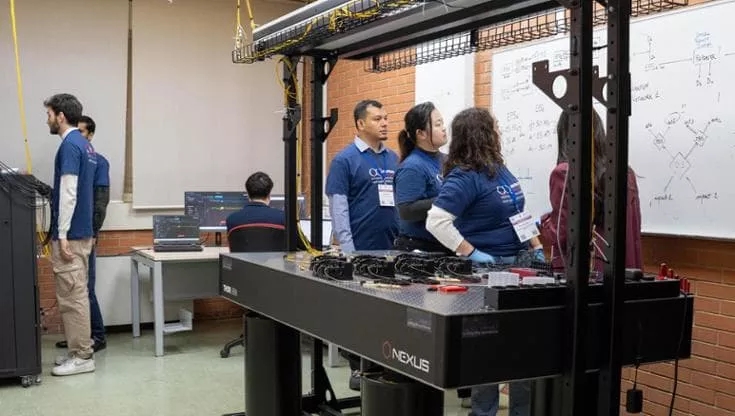
On Friday, January 16, 2026, the University of Naples Federico II — the oldest public university in the world, and incidentally the one where the author of this post studied for his BSc — officially inaugurated Italy’s first Quantum Internet Testbed.
The launch took place during a strategic workshop titled “Towards a National Quantum Internet Infrastructure”, which brought together academic leaders, government officials, and major industrial partners.
We were honored to be among the guests, and we also got a tour of the lab. Since this took place in the campus where I attended classes during my BSc, it really felt a bit like a memory lane moment for me, which was quite nice!
Quantum Internet Testbed
The event was focused on presenting the Quantum Internet Testbed, a physical platform to test how quantum networks (using entanglement and quantum repeaters) can coexist with standard classical internet traffic. The project is led by Professors Angela Sara Cacciapuoti and Marcello Caleffi, members of the Quantum Internet Research Group at University of Naples Federico II.
A major focus of the testbed is Quantum Key Distribution (QKD) without trusted nodes and using commonly available — that is, not polarization preserving — fiber optic. This goal is very dear to us, as this kind of hardware infrastructure is exactly what we need to run our protocols.
Indeed, a way to efficiently summarize the ideas presented is “TCP/IP for the quantum internet”. Lack of a common standard is one of the biggest pain points of modern quantum internet infrastructure, so we were very pleased to see developments in this direction.
Institutional presence
The presentation was not just a technical demo but a strategic summit to align Italian stakeholders on a national quantum roadmap. The event featured interventions from the National Cybersecurity Agency, the Ministry of Foreign Affairs, and the Ministry of Enterprises (MIMIT). Undersecretary Alessio Butti sent a video message emphasizing the need for a “common language” between physicists and engineers to build a national quantum community. Indeed, a problem with the Italian quantum landscape at the moment is its fragmentation: there are many different initiatives backed up by different Italian universities and government agencies. All these initiatives are connected and talk with each other, but “from the outside” they appear disconnected, making it very difficult for foreign stakeholders to find their bearings.
Besides us, many high-profile industry representatives attended, including delegates from Airbus, Leonardo, TIM, IBM, Thales, and Huawei. This underscores the testbed’s goal of fostering a “multi-vendor” environment where different technologies can work together.
The initiative is supported by funds from the PNRR (National Recovery and Resilience Plan) and the RESTART Foundation. It represents the culmination of a long “stealth” development phase, now moving into active field testing.
To wrap up
Perhaps a bit surprisingly, Napoli is coming up as one of the most interesting cities for the development of quantum tech in Italy and Europe in general, especially when it comes to university research. Indeed, last year the university already unveiled its superconducting universal quantum computer, the first of its kind in Italy. It is very nice to see the same university following up on quantum communication hardware. We look forward to be able to test their infrastructure with our protocols, all while eating delicious pizza since we’re at it!